Archive for the 'Denver' Category

The Old Cemetery is Dying

Wednesday, February 6th, 2008

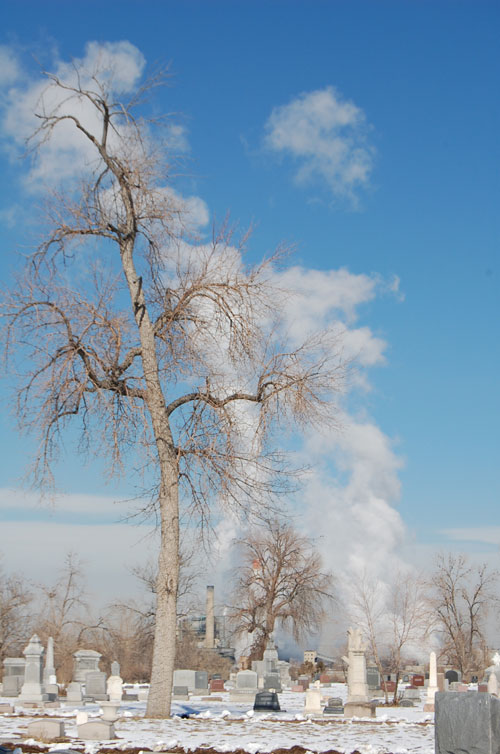
Riverside has been dying for a long time.

One of the first cemeteries in the american west designed as a park, with paths for carriages, and trees for shade, and roses, for a generation or so Riverside served as the resting place of the pillars of society, territorial governors and mayors and pioneers and publishers. It was filled with statuary and civil war heroes and abolitionists and shady characters and mothers who died in childbirth, and lots of children who died too young.

But it was downstream from the city, in an industrial area near the city of commerce, and it ended up on the wrong side of the tracks. Even before the Railway line came through, the wealthy had moved on to another part of town. Riverside was left to the working men and the working women, to immigrants and laborers and indigents.

And so there began a long, slow decline, the slow death of a place honoring the dead, exacerbated by the western thirst for water. It’s too far gone now, in many ways. Trees have died, and roses, and there will never again be kentucky blue grass between the graves. In the end, the old resting place will settle back into the dusty plains, as we’ll all settle into oblivion.

There is something profoundly human about the desire to immortalize ourselves with a mark in time. Perhaps it explains the creative impulse, the desire to say “I was here, now.” Or to commemorate a loved one with as generous a statement as you can afford.

In the early days of the american frontier, the cemetery was a primary form of expression, perhaps the only way for most people to say, I was here. I loved. I made my mark. And there is sadness in the realization that of all the monuments, each one for someone who lived and loved an died, so few stories survive.

There is an austere beauty to the prairie, and at Riverside it’s poignant given the location between the smelter and the refineries. It’s not a traditional beauty, not fecund and rich and fertile, but more elusive and fleeting and dry. Like the west, the prairie scene doesn’t give away it’s secrets. They are too valuable to waste on the unobservant.

Times change; the cemetery is no longer the tradition it once was. Burial is now the exception rather than the rule. Still, there’s something to looking to the past, something to gain from saving what’s left of this history.

For a while at least. Until oblivion.

STORY: at the metro center for visual arts

Wednesday, January 9th, 2008

Hadley, along with Brent Green and James Surls, is exhibiting in the current show at the Metro State Center for Visual Art. Entitled “Story”, the exhibition “brings together three artists whose artwork has a tale to tell. The exhibition is a profound collection of works that delve into created realities and visually realized narratives of the strange and familiar.”

When I met hadley, 19 years ago or so, I was immediately struck by the incredible layers of meaning in her paintings and sculpture. I remember commenting that nothing in her work is what it seems on the surface. It’s not surprising I suppose, given my interest in stories, that I fell in love with a woman who is a better storyteller than I am. I’m sure the understanding of narrative is part of why hadley is such a successful illustrator, but her paintings are another level of expression, and really where she puts her heart.

Narrative in the visual arts has come back into style since the heyday of the abstract expressionists.Today, I don’t think many people would stand behind this quote from Clive Bell, which he wrote in support of the abstract expressionists non-objective paintings:

The representative element in a work of art may or may not be harmful, but it is always irrelevant. For to appreciate a work of art, we must bring with us nothing from life, no knowledge of its affairs and ideas, no familiarity with its emotions.

Like a good pop song, the best narrative paintings tell open-ended stories. As Mary Chandler wrote in her review of the show in the Rocky Mountain News, Hadley’s work consists of “lushly textured paintings - paint, ink and toner on Venetian plaster - that follow one of the big rules of art: that work should ask as many questions as it answers”

Kudos to the team at the CVA, who have paired hadley with Brent Green, who creates brilliant animations (as well as working with musicians like Califone and Giant Sand and Fugazi among others), and James Surls, who builds fascinating hanging sculpture; the show holds together really well.

The show opens with a public reception on Thursday, January 10th from 7 to 9pm. More information is available on the CVA website.

riverside is an honorary rino

Tuesday, December 4th, 2007

It’s official. Riverside Cemetery has been made an honorary RiNo.

RiNo is the River North Art District. Now the only art district with its own cemetery.

Read more on the RiNo blog, and read the RiNo Crow here.

riverside cemetery blog created

Thursday, November 1st, 2007

Things are moving along with the Friends of Historic Riverside Cemetery project. We’ve created a blog, and today Jan was interviewed for Colorado Matters at KCFR. Also, we’ve been contacted by people from the Colorado Genealogical Society and Colorado Preservation. Hopefully we’ll have a productive meeting on November 17th.

Read more or get involved at friendsofriversidecemetery.org

DoubleButter is Better

Tuesday, October 30th, 2007

This is the best story I’ve heard in a long time. Apparently sometime today a couple of entrepreneurial local furniture designers delivered and installed some nicely designed benches to both the Libeskind addition to the Denver Art Museum and the brand new David Adjaye Museum of Contemporary Art Denver.

They apparently did a meticulous job on the installation, and the benches look fabulous. The only potential issue? They were engaging in guerrilla design. To the best of my knowledge, no one has been arrested. Yet.

Oh, and they videotaped the whole thing. Watch the video at doublebutterisbetter.com.

Or on youtube at:
http://www.youtube.com/watch?v=e6c0RoD8GTY

Chase DeForest at Ironton Studios

Tuesday, October 30th, 2007

I’m looking forward to the show that opens at Ironton on Friday November 2nd for a number of reasons. First, the work is constructed with terrific craftsmanship and attention to detail. Second, it shows that boundaries between art and craft continue to break down (and therefore supports the value of the local and the artisinal). And third, it just plain fun.

The show is called “Sporting and Recreation: Furniture” and the work is by Chase DeForest. Chase has an MFA from RISD, teaches Industrial Design at Metropolitan State College in Denver, and works for the Denver Office of Cultural Affairs on the Clifford Still Museum project. And somewhere along the line she finds the time to create her own work (as shown below). More information is available at irontonstudios.com or chasedeforest.com.

Saving Riverside Cemetery

Monday, October 29th, 2007


I was quoted in the Denver Post this morning regarding my interest in Riverside Cemetery, along with my friend Jan Allan and Father Joe Hirsch of Transfiguration Cathedral. The article, entitled “Group hopes to bring new life to cemetery” was written by Tom McGhee, and I’m really grateful to him for all he did to bring this story to light.

My personal interest in Riverside did not come about because of a personal relationship; unlike many of the people who are involved in trying to save (resuscitate?) the resting place of 67,000 people, I don’t have family interred there.

I’m interested in the cemetery partly as a historical site; it is Denver’s oldest cemetery, and the first in the Rocky Mountain West to have a ‘park-like’ design. There are a remarkably broad range of people buried there, from a Negro League baseball player, several governors and other famous people, hookers, newspapermen, civil war veterans, and an incredibly diverse range of race, religion, and background. I’ve walked around Riverside any number of times it seems I’m surprised by something every time I go there.

But perhaps even more than its history, I am drawn to Riverside by its enduring presentation of the cultural and creative artifacts of the past 150 years of Colorado history. There were some photographers and painters working in Colorado in the latter part of the nineteenth century, and there were artisans working with wood and stone. But for the average person, the gravestone might well be the single most important piece of sculpture and the most heartfelt expression of their lives and sorrows.

The truth is that Riverside has both historical and cultural significance, but has been sorely neglected over the years, and the Fairmount Cemetery (who have owned Riverside since 1900) didn’t do anyone any favors by losing the water rights in 2003. For whatever reason, Fairmount has treated those interested in supporting Riverside as an annoyance, even though our interest was based only in wanting to see the condition of the cemetery improved.

The only way to improve the condition of this little known historical gem is to increase the awareness to the public; I wrote back in April that the ideal solution would be to turn it into a park along the Platte River, but it seems unlikely that it will be taken over by the Denver and Adams County Government. Perhaps this bit of additional press will help Fairmount to understand that it is in their best interest to coordinate and collaborate with those of us in the general community who care about the welfare of their poorer, dustier, and more historic relation. In any case, Jan and I are planning to get a meeting of “Friends of Historic Riverside” scheduled in the near future.

Update October 31st:
Here’s the info on the next meeting of the Friends of Historic Riverside Cemetery:

Date and Time:
Sat., Nov. 17, 2007, 11AM

Holy Transfiguration of Christ Cathedral Meeting Hall
349 E 47th Ave
Denver, CO 80216
www.transfigcathedral.org

Let me know if you’re planning to attend.

Denver Culture in the news

Friday, October 26th, 2007

Gene Sloan wrote and article that was posted in USA Today today about the burgeoning cultural scene in Denver. It’s not a fantastically in depth article, but it does show off a couple of Denver’s lesser known treasures, the Dikeou Collection and the Kirkland Museum.


The Dikeou has a fabulous collection of contemporary work ranging from a giant pink inflatable bunny by Momoyo Torimitsu (pictured above) to Vic Muniz and (personal favorites) The Royal Art Lodge. But, you would never know it was there unless you’re looking for it. It’s located in an old nondescript office building just off the 16th street mall in downtown, and is only open wednesday through friday from 11 to five.

The Kirkland Museum is of particular interest to designers for its extensive and fascinating collection of twentieth century decorative arts. It’s located at 13th and Pearl in Capital Hill, and is open every afternoon but mondays.

Since I moved back here 20 years ago, the Denver community has struggled to build an infrastructure that supports the creative economy – it’s good to see some results of this effort. Of course, the scene isn’t close to consistently good, and there isn’t the density of some of our coastal cities. But, there’s an increasing awareness of the benefit the cultural component offers to the texture of the city.

Museum of Contemporary Art Denver Opening

Thursday, October 25th, 2007

The newest addition to Denver’s cultural landscape is opening with a series of events this week; the Museum of Contemporary Art Denver (MCAD) building is the first designed by David Adjaye to be built in the United States, and it is a jewel, and serves as a fascinating counterpoint to the Libeskind addition to the Denver Art Museum.

The building is still very much under construction, but Hadley and I have had the chance to see it a couple of times, first in a hardhat tour and then last evening at a members reception. Here’s a photo she took of the building exterior from a couple days ago:

Where the Libeskind is muscularity and gesture, the Adjaye is functionality and grace – the MCAD is unassuming with its square frame and translucent skin, inside it holds a surprising amount of exhibition space very efficiently organized. Once you enter the building, it feels that the outer walls serve as a shell around two separate spaces, each set on a slight angle from the primary grid. Within these there are openings that slice the space in slight diagonals.

The opening exhibitions are appropriately diverse, with the largest gallery dedicated to the work of David Altmejd of Canada. I snapped a couple of phone photos last night of his installation; with its fractured reflections and creatures looking like something out of the transformers movie, it may not be the richest in terms of meaning, but it’s an impressive presentation in any case.

It’s unfortunate that the building wasn’t open a couple of weeks earlier - I heard from a number of attendees at the AIGA National Conference that they were hoping to get to see the space. Nonetheless, having a notable space dedicated to the presentation of contemporary work bodes well for Denver’s maturing art and design community.

And, we’re looking forward to making use of the members cafe on the rooftop, which also includes some gardens planted by Karla Dakin. The gardens were built and planted at Ironton, and then hoisted to the roof by crane. Hadley took some photos and turned it into this charming animation:


Thanks to Andy Bosselman for youtubing it.

Designing What’s Next

Wednesday, October 3rd, 2007

Next week more than 2,000 designers will be heading to denver for the AIGA 2007 conference. One of the presentations I’ll be looking forward to seeing will be made by Khoi Vinh, the design director at NYTimes.com.

Khoi will be speaking on the topic of ‘Control’. Here’s how the program describes it:

There’s a fundamental shift going on in design: CONTROL is passing from designers to design consumers, and it’s changing the way we practice our craft. For most of design history, we’ve judged the best designers on how successfully they’ve exerted control in their work. Control over ideas, over typography, over imagery, over the means of production–the more control the better.

It’s interesting that someone who works for the New York Times, one of the most carefully controlled websites in existence, would choose to talk on this topic. In this case, I mean ‘carefully controlled’ as a compliment - for the dozen or so years I’ve been using the web, nytimes.com has been my primary news portal for all of them. Of course, Khoi does other terrific design work as well – his blog, subtraction.com is a fantastic source of information on a variety of topics. And, he also takes good care of his dog, mister president, which is the best name ever for a dog.

I’m interested in his presentation because for the past nine months I’ve been working with a number of other Colorado designers exploring the topic of what’s next in design. We’ve talked about (and designed the conference materials by) collaborating in small groups, doing rapid prototyping, using design charrettes, and a lot about giving up control.

We’ve had over 30 different designers working on various components of the conference marketing collateral, and we developed a ‘brand’ that was all about providing a framework for design, rather than a heavily controlled set of rules. It has been a robust and valuable discussion, an exciting exploration, and a lot of work.

Now, as the conference approaches, we’ve launched an opportunity for the conference attendees to get involved in the discussion; through aiganext.com we’re hoping that the framework we’ve created will provide a launchpad for more discussion and more design innovation. We’ll be adding some additional features as the week goes on (including flickr photo tags) but at this point we’re hoping that conference attendees will add their profiles and their thoughts on ‘what’s next’, venues for visiting, and ‘bird of a feather’ events beyond the substantial events already sponsored by the AIGA.

None of this would have been possible without the substantial efforts of numerous colorado designers, including my core group cohorts, Fred Murrell of RMCAD, Craig Rouse of R Design, and Jason Otero of Art & Anthopology. aiganext.com is largely the result of a collaboration between myself and Sean and Todd at DayJob. Now, we’re giving up control. Visit aiganext.com and help decide what’s next.