Archive for the 'Social Justice' Category

animal cruelty and the food supply

Sunday, February 17th, 2008

There are a lot of reasons to eat less meat, including personal health, the impact on climate change, and other environmental impacts, including pesticides and waste in rivers and waste in the water table.

And then there’s the issue of factory farms in general, and the question of how to assure that giant meat producers follow standards of quality and ethics. Large corporations, with a focus on the bottom line, place tremendous pressure on their employees to engage in unsafe and unethical practices. These bring out other concerns, including broader health concerns and the treatment of animals.

Today, the USDA announced the recall of 143 million pounds of beef produced by Westlake/Hallmark, based on the evidence presented in the following video, produced by an undercover reporter for the Humane Society of the United States. Before you watch it, you should know this video is one of the most disturbing things I’ve seen in a very long time.

In this facility, cattle who cannot stand on their own are lifted, rolled and speared by forklifts. Another has water shot into its nostrils to simulate drowning (cattle waterboarding, I suppose), and others are beaten in a routine and horrifying way. All in order to get sick cattle passed by the inspectors so they can be put into our food supply.

Unfortunately, most of the meat produced at this facility has already been eaten, and much of it (perhaps 37 million pounds) by children through school lunch programs. Two employees have been fired and charged with animal cruelty, but there are clearly deeply entrenched problems within this industry that aren’t addressed by punishing a couple of workers on the line. All in all, a deeply disturbing episode.

The Designers Accord

Tuesday, January 15th, 2008

I joined the Designers Accord this past week.

What is the Designers Accord? According to founder Valerie Casey, it “is a call to arms for the creative community to reduce the negative environmental and social effect caused by design.”

I think of it as a more modern version of the hippocratic oath for designers. It’s not just a call to arms, it’s a code of ethics, a responsibility to think through every decision you make as a designer with as much perspective as you can muster.

In fact, the first tenet of the code of conduct expressed on the site is “do no harm”. This term, derived from a core tenet of medical practice (though not, in fact, from the hippocratic oath - the term Primum non nocere has been used for the past 150 years) is essentially conservative in nature. Don’t do anything to make the situation worse. A good start, though not going far enough. The code of conduct continues:

Do no harm
Communicate and collaborate
Keep learning, keep teaching
Instigate meaningful change
Make theory action

The Designers Accord focuses primarily on environmental components, though I believe that there are social justice components implicit in the initiative as well. And it is not just designers who should consider these issues - though designers have been responsible for making more than their fair share of trash in the past. But this is a consideration for all of us in our daily lives.

In her (newly reinitiated) column on design in the New York Times yesterday, Allison Arieff says that the Designers Accord is going to be endorsed by both the American Institution of Graphic Arts (AIGA) and Industrial Design Society of America (IDSA). She also says:

Recognizing the near impossibility of changing consumer behavior and business behavior alike, the Designers Accord asserts that these firms, which design everything from graphics and packaging to user interface to final product, are ideally suited to get the design-for-impact conversation rolling.

In some ways these are heady times for designers. Rock star architects and product designers for Target and the latest electronic gizmo. But there has to be a way to creatively engage each client, each individual, in a conversation that pushes all of us to provide more value with less impact.

Kudos to Valerie Casey for starting this initiative. Now, let’s get to work.

Pressuring China on Burma and Darfur

Wednesday, October 10th, 2007


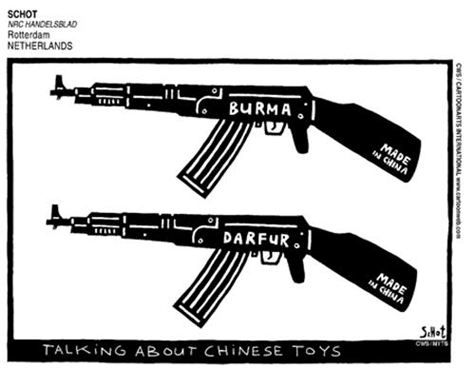
Christopher Hitchens is both exasperating and, occasionally, correct. I tend to disagree with his conclusions on many topics while finding his analysis pertinent to the discussion. For instance, he published a column on Slate this past week titled “Maintained in China: Burma’s Foul Regime Depends on China” that correctly points out that Chinese support is crucial to the continued existence of two of the world’s most repressive regimes in Burma (Myanmar) and Sudan. In the article he makes the following point:

Is there an initiative to save the un-massacred remains of the people of Darfur? It will be met by a Chinese veto. Does anyone care about Robert Mugabe treating his desperate population as if it belonged to him personally? China is always ready to help him out. Are the North Koreans starved and isolated so that a demented playboy can posture with nuclear weapons? Beijing will give the demented playboy a guarantee. How long can Southeast Asia bear the shame and misery of the Burmese junta? As long as the embrace of China persists.

He follows up this pertinent analysis with the conclusion that “Meanwhile, everybody is getting ready for the lovely time they will have at the Beijing Olympics. If there could be a single demand that would fuse almost all the human rights demands of the contemporary world into one, it would be the call to boycott or cancel this disgusting celebration.”

In this ‘demand’ I think he is being both naive and perhaps a bit disingenuous. Does he really believe that the right solution is to “cancel this disgusting celebration”? My personal belief is that the Olympics should be used as an opportunity for supporters of social justice and human rights to pressure the Beijing government without resorting to the untenable threat of a boycott or cancellation.

I can across a site today that takes a more sophisticated and realistic approach. Olympic Dream for Darfur focuses on ‘protecting civilians on the ground in Darfur.’ They go on to say that:

Our goal is to protect civilians on the ground in Darfur. To achieve this, the government of Sudan must allow a robust civilian protection force into Darfur.

Because of China’s extensive economic interests in Sudan, leaders in Beijing are in a unique - indeed unrivaled - position to persuade Sudan to consent immediately to a true and robust U.N. operation in Darfur.

The two roles China is playing – host of the Games that symbolize peace and supporter of a genocidal regime – are inconsistent and must be reconciled.

Dream for Darfur specifically says they are not supporting a boycott of the Olympics, but goes on to say that with “the privilege of hosting the Olympics come responsibilities, including the obligation to live up to the spirit of the Olympics, which means acting as a global leader for peace.”

I’m looking forward to seeing the same type of pressure being applied to China regarding Burma as is being put forward on Darfur. Certainly it will take patient effort, but the eyes of the world are on China, and it is time for the Chinese government to consider more than economic growth as they solidify their position as the preeminent power in the asian world.

Storytelling for Good Causes

Thursday, February 8th, 2007

Len Edgerly sent me a link to a podcast by Andy Goodman called Storytelling for Good Causes on the Social Innovation Conversations website. The presentation was given at Stanford University last fall to a group of social innovators over the age of 60. It runs about 45 minutes long, but is definitely worth a listen, especially if you work for any organization working for social change.

Andy offers a great overview of why stories are the way we understand ourselves and others; our history, identity, culture, and memory are all defined through narrative. He then relates Robert Reich’s four stories that define the american psyche: Mob at the Gates, the Triumphant Individual, Benevolent Community, and Rot at the Top. You can read them on Reich’s site in this article entitled The Lost Art of Democratic Narrative.

The presentation ends with a series of stories told by the attendees at the conference. As the old axiom goes, the proof is in the pudding. As Goodman says, we have to tell our stories to everyone who will listen. The powerful stories of individuals can help to change the world.

The Ruthless Pursuit of Affordability

Thursday, January 25th, 2007

Paul Polak of IDE talks about the ruthless pursuit of affordability in all of the design work that his organization takes on. Of course, the IDE $20 water pump is a great example of how we can bring the poorest of the agricultural poor up from $1/day to $2/day, thereby taking them out of destitute poverty.

But what about the stylish poor, the destitute who want to smell good? According to this article in The Onion, Chanel has finally taken this into account and developed a “cost-efficient fragrance for the Third World, one specifically designed for the rigors of dry, dusty, less glamorous environments in the Southern Hemisphere.” Called Chanel 3rd, “it can go from hut to field to fire circle without losing its potency or charm.”

About time, I say.

IDE gets 13 Million from Gates

Friday, January 19th, 2007


When I left Sapient (five years ago now) one of the commitments I made to myself is that I would do work for organizations dedicated to changing the world. I’ve been fortunate to work with several non-profit/NGO organizations that are engaged in socially progressive development. One of these is International Development Enterprises (IDE). IDE has done tremendous work in improving the lot of the world’s poorest people. They have brought millions of farmers out of poverty, mostly my improving irrigation techniques.

According to Paul Polak, founder of IDE, there are over a billion people in the world living on less than one dollar a day. In their case, getting out of poverty means moving from one dollar a day to two dollars a day. Their core product is a treadle pump, which allows human-powered irrigation, as well as a series of other, mostly related products.

IDE is an amazing organization, but not one that is particularly well known outside the development realm. For instance, they haven’t put the amount of energy that Heifer International (another group I’ve worked with) has into grass roots fundraising. So, it’s great news that IDE has received 13 million dollars from the Gates Foundation for their efforts. My understanding is that this will double the budget of IDE. Pretty incredible.

What is not clear to me is whether this is an ongoing commitment, or a one-time bequest. My hope is that IDE will take this as an opportunity to improve their awareness in the broader community so that this seed money can serve to establish a strong ongoing base of operations.

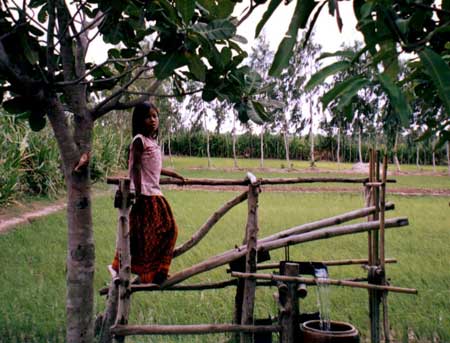
Here’s a picture of the treadle pump in action:

Living Cultural Storybases

Friday, December 8th, 2006


I saw this on the worldchanging blog today:
www.worldchanging.com/archives/005521.html

According to their website at storybases.org, the purpose of the organization is as follows:

To nurture the oral heritage of minority cultures in a digital world by combining:

• A trustworthy participatory process that engages and empowers the youth, dispersed communities and displaced members of minority cultures to embrace and grow their traditional narratives.

with

• A generalizable technology which provides appropriate, two-way access for all the population and a dynamic audio database architecture that reflects the culture, inviting further contributions and stimulating internal social debate.

Pretty good idea, I say.

Eyes Wide Open

Thursday, December 7th, 2006

Two years ago I worked with the American Friends Service Committee to create a three minute movie honoring the dead in Iraq, both American and Iraqi. It’s part of their “Eyes Wide Open” project, where they display a pair of boots for each American serviceperson killed in the war.

I’m very proud of the movie; it’s incredibly moving and was frankly very emotional to work on, probably the most gutwrenching project I’ve ever done. We sorted through hundreds if not thousands of photos, and culled them down to just those that best expresses the pain and suffering of all those who are part of this misguided conflict.

Now, two years later, we are approaching another milestone; very soon, we will pass 3,000 American dead in the conflict. Of course, this doesn’t begin to count the many tens (hundreds?) of thousands of Iraqi’s killed, nor those injured or whose lives have been ruined. I went back and looked at the code of the movie I built (we count the Americans killed), and two years ago the number was 1,400.

I think the most disturbing part of this experience is how little change we were able to effect. I admire the folks at the AFSC for their dedication, and I suppose there is some late (very late) admission that the invasion was a mistake. But the suffering goes on, and gets worse. Our country’s image has been wrecked abroad, and we are still divided at home. The human cost and the financial cost are frankly beyond imagining.

Anyhow, here’s the link if you want to see the movie:
www.afsc.org/iraq/

What is Conservative, anyhow?

Thursday, November 30th, 2006

I’ve often wondered how long the tax-cutting as good governance faction of the Republican Party would be able to stay in control of things. My paranoid idea (shared by some) is that this group wants to build such a huge deficit that we’ll have no choice but to get rid of any safety net and drive our society back into the dark ages, thus bringing forth the inevitable beam up of all good persons into heaven. It’s the coalition of the trickle-down reaganites and the social conversatives that will lead to the end of civilization as we have come to know it.

But not all republicans are in this evil cabal; this week in the New York Times, Ben Stein put forth a call for reason - you can read it here. He used Warren (no longer the richest man in the world) Buffet as the cover fire for his attack, but what’s strange is that he even had to make the argument. All he says is that we have to pay our way as we go, and not leave a huge debt to our children. And if we have to raise taxes to do it, so be it.

I don’t believe that government is always good, and certainly it would be nice to get rid of the pork appropriations and run things more efficiently. But there are some programs that should be run by government. If we want the services (whether it medicine, roads, or defense), then we have to pay for them. I don’t agree with a lot of what we spend our money on, and we may well be leveraging our way into bankruptcy as a country, but the least we can do it agree to pay our the bills.

I’m looking forward to seeing an end of the idiotically simplistic “cut taxes and all will be well” form of governance – tax cuts should always be connected to spending cuts. But I’m not hopeful. I’m afraid we are all too tempted by this form of pablum. Ah well, so be it.