Archive for the 'Denver' Category

summer culture

Tuesday, June 5th, 2007

Summer is a time for casual enjoyment in a reflective but less serious manner. In Denver, the best of summer culture happens in Lakewood at the Lab. The Lab at Belmar is a somewhat eccentric art space in a new urbanist development; it’s run by Adam Lerner, who is committed to establishing a world-class arts venue in a Denver suburb. So far, he’s doing a pretty good job of it; in the first year he’s put on shows by Isaac Julien and Liam Gillick. But, it’s not all super serious; Adam and his team realize that you have to have some fun to get people out to the ‘burbs.

In the summer, Adam puts on a great series called “mixed taste”, which is a series of programs combining tag team lectures on unrelated topics. It goes on all summer - this Thursday, it’s Swiss Typography and TV Theme Songs. Next week, Kurt Cobain and Solar Eclipses. And it goes all the way to the end of August, with an estimable finale: Marxism and Kittens, Kittens, Kittens.

The lectures are short, to the point, and entertaining. If you don’t like it, there’s another one coming shortly. And, while you’re there, check out the exhibit of Fang Lijun’s Heads, including the main room showing over 15,000 individual heads. Impressive. Visit the lab site at belmarlab.org for more information.

Art and Architecture

Thursday, May 24th, 2007

This afternoon, I was down at PlatteForum – the current installation, by one of Denver’s most original creative thinkers, Michael Ensminger, is really great fun.

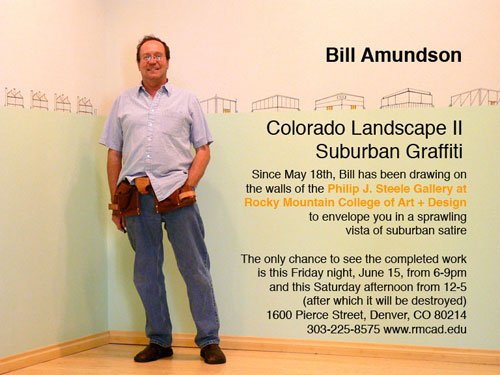
A city of buildings, some ten feet tall, built out of lincoln logs. A miniature trip through the Chicago loop, but with a global range of styles (as long as the styles are available as part of the miniature log home industry). No glue, just gravity.

While I was there a train passed by, and we all heard something fall off the installation. It turns out one of the asian influenced buildings lost an adornment off its roof.

Part of the installation’s charm, besides the obvious connection to the nostalgia and americana, is the temporality of the experience. The truth is, all our constructions are temporal.

Stewart Brand wrote a book published in 1994 called “How Buildings Learn”; according to Publisher’s Weekly:

All buildings are forced to adapt over time because of physical deterioration, changing surroundings and the life within–yet very few buildings adapt gracefully, according to Brand.

Some years ago, Brand started a group called The Long Now Foundation; the term was actually coined by the musician, artist, and longnow co-founder Brian Eno. The Long Now Foundation was created by some serious minds. I like this detail; The Long Now Foundation uses five digit dates, the extra zero is to solve the deca-millennium bug which will come into effect in about 8,000 years. Here is the basis of their argument.
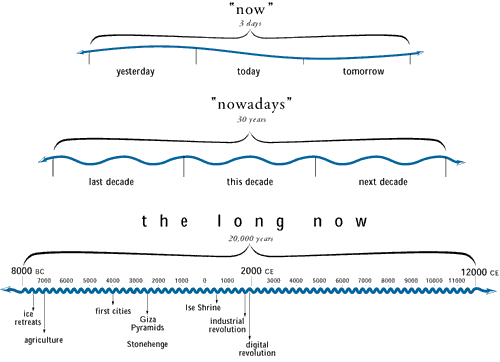
I’m a gardener by avocation; I think in terms of seasons, and (when I’m paying attention) years. Some artists have a vision that takes them across decades. In a rare case an architect thinks of centuries. But the fact is that our viewpoints are based on far too short a timeline.

One of the initiatives of The Long Now Foundation (and they are numerous) is The Clock of the Long Now. According to the project initiator Daniel Hillis:

“When I was a child, people used to talk about what would happen by the year 2000. For the next thirty years they kept talking about what would happen by the year 2000, and now no one mentions a future date at all. The future has been shrinking by one year per year for my entire life. I think it is time for us to start a long-term project that gets people thinking past the mental barrier of an ever-shortening future. I would like to propose a large (think Stonehenge) mechanical clock, powered by seasonal temperature changes. It ticks once a year, bongs once a century, and the cuckoo comes out every millennium.”

They are currently working on the second prototype. The first prototype was finished in 01999. I’ll be gone by the next time it ‘bongs’ in 02099.

The Dreaded Concept Album

Thursday, May 3rd, 2007

This Saturday afternoon at 5:00pm the city is Denver will suffer an invasion. A small invasion, but one that should be watched closely for clues as to the future of our culture, our families, our very lives. This Saturday the Inactivists launch their third release, “The Dreaded Concept Album.”
The makeup of the band should give you some sense of the risk involved; any band with a clarinet, a theremin, and a ukulele is bound to be dangerous. And then there are the song titles. For instance, I’m oddly drawn to “Bearded Nuns in Bondage,” which I just gave a listen on their myspace page; I found it to be a pleasant uptempo ditty on a topic I’ve never spent a lot of time thinking about.

On the other hand, I have no idea what caused them to write “fuck you singer songwriter.” And today is Pete Seeger’s birthday. The shame. These may be the geekiest creatures on the planet. The show is at the Larimer Lounge. The Secret Service should be notified. More information and free tickets are available on the Inactivists website.

Colorado Parkour

Friday, April 13th, 2007

jhh and I watched “Casino Royale” last week. The verdict? Daniel Craig makes a decent James Bond. The movie got incredibly boring once they started playing poker. And the opening scene was one of the best action sequences I’ve seen in a movie in a long time.

It turns out that the opening sequence is performed by a french fellow named Sébastien Foucan, in an activity he calls ‘freerunning’, and freerunning is similar to Parkour. All this is fleshed out in some detail in the April 16th issue of The New Yorker (No Obstacles, by Alec Wilkinson). The article meanders a bit, but (as reported on the westword blog) there is a substantial Colorado contingent of ‘traceurs’, led by Ryan Ford. This video shows some of the craziness, and there’s more on their website at coloradoparkour.com.

Dum Tacet Clamat

Tuesday, April 3rd, 2007

“Though silent, he speaks”

In cemeteries throughout the west, Dum Tacet Clamat is written on hand-carved gravestones paid for by an insurance company called the Woodmen of the World. In an era where people had no other form of insurance, they made sure that their ultimate resting place would have an appropriate marker.

Jill and I ran into Dennis Gallagher (Denver City Auditor, Historian, and Raconteur) last Saturday; it turns out that we share an interest in preserving one of the unique parts of Denver’s cultural history.

A hundred or so years ago in the western United States most people didn’t worry much about art; there were more pressing concerns. Looking back from a distance, the most significant works mostly went in two directions; either they were architectural, or they were in cemeteries.

Denver’s most significant (or at least compelling) collection of funerary art is in Riverside Cemetery, located north of downtown off Brighton Boulevard. Jill and Maddie and I go walking there a couple times a week; it’s by far the calmest, most private place in the city. (If you’re interested, I’ve posted a few photos of Riverside as a set on Flickr.

Unfortunately, Riverside is drying up and falling apart. This evocative collection of stories about the people who founded Denver, who lived and died in Denver, is barely hanging on. A few years ago they lost their water rights (even though the cemetery is right on the banks of the Platte River). So now the trees are dying, the grass is brown, the old roses aren’t making it through the hot summers anymore. It’s a shame.

The city of Denver should buy Riverside and turn it into a park; sure, it’s in the middle of an industrial area, but industrial areas close to downtowns are being renovated all around the country.

We’ll see what happens with this; hopefully Dennis and his buddy Tom Noel can raise some awareness about this little known jewel. Riverside has a lot to say. It’s just lacking the right voice to say it with.

Best of Denver

Friday, March 30th, 2007


I returned from a week on the western slope suprised to find out that this very blog has won an award from Westword for “Best Blog — Cultural“. I was shocked, shocked I tell you. Really. Then I looked at the web page and found out that the readers’ choice went to ‘Slacker and Steve’. Turns out Slacker and Steve are the afternoon DJ’s on Alice 105.9, and they don’t even have a blog. Tough competition. But awfully nice of Westword to give this little side project a mention. I’ll take it as a raising of the bar and a challenge to do more with it in the future.

When I think about it, I’m not sure there is a lot of Denver-based art and culture blogging going on. Westword has a good one called “The Latest Word” (though they couldn’t really give the award to themselves) and 5280 Magazine is better in blog than in print. I enjoy my RSS feeds from The Urban Brain and Denver Infill, but they are primarily about living and building in the city, respectively. Tracy and Jill set one up for the River North Art District, but that’s neighborhood specific.

So, that raises the question. Who is writing about art and culture in Denver? Let me know if you have any ideas…

Recurrent Nightmare

Thursday, March 29th, 2007


The current show at Ironton is really cool. Chelsea Hunt has created ‘an installation of miniature proportions’; it’s intelligent, humorous, and disturbing at the same time. She created engaging scenes of tiny characters with frightening figures looming over them. The same sort of figures that used to loom over me when I was a little character. And now, as I look down at the little characters, I am one of the looming figures.

The artist reception for the show is this Friday, March 30th, from 6-9pm, and the show continues through April 21st. More information is available on the ironton website, irontonstudios.com.

North Denver Italian Culture

Wednesday, February 14th, 2007

I just spent the weekend working with a group of Italians creating digital stories (through the Center for Digital Storytelling, storycenter.org) about their lives in Denver and Colorado. It was amazing how many of the stories had Highland connections.

For instance, Duke’s story was all about Mount Carmel Church. He was baptised there, his sons were baptised there, his grandkids were baptised there, and he hopes his great-grandkids will be baptised there soon.

Louis Polidori, whose family still makes sausage near 33rd and Tejon, told the story of growing up during the depression behind the market at 34th and Shoshone (the market is now the home to our friends Jim and Michael). According to my buddy Michael Thornton, who grew up in the hood, Polidori sausage is the best in town (as a vegetarian I’ll just have to take his word for it). They are now being made by the fourth generation of the same family. check it out at: polidorimeats.com.

There were stories of holiday meals on Shoshone street, with homemade wine for the adults and sprite for the kids, and memories of the grandparents house on Osage. And I got to help Jess Gerardi create his story. Jess plays the trombone, was the director of the Englewood Marching Band, and is the sixth director of the Denver Feast Band. The Denver Feast band has been around since 1895 and plays at the feast of St. Rocco and other events. It made me wish summer was here so I could go play bingo and gamble to win olive oil at the Mount Carmel fair.

It’s great to be in a place where there is so much history. What’s frightening is that so much of it is at risk of being lost.The Italian stories will be shown at the Colorado History Museum downtown starting in April. I know that many of the Highland stories have been recorded in oral histories and lots of photos have been scanned. But many more, even most, are bound to be lost.

Hopefully this group can serve as an opportunity to make sure we don’t forget.

Libeskind finds apologists

Sunday, February 4th, 2007

In an article in today’s Denver Post entitled Pro-Libeskind forces fire back, Kyle MacMillan cites two influential critics coming to the defense of the new Hamilton wing of the Denver Art Museum. Most interesting is the assessment of Suzanne Stephens of Architectural Record:

Regardless of the controversy about the display of art within the canted gallery walls, the jagged building is a surprisingly successful tour de force on urbanistic grounds alone. It revitalizes an area of downtown Denver between Civic Center Park, the location of the Colorado State Capitol, and a dilapidated district to the south dubbed the Golden Triangle, now in the process of being gentrified with housing, art galleries, shops, and restaurants.

I’ve read a number of the previous reviews critical of the space and, although I’m somewhat critical of parts of the design, I felt the initial reaction was a bit harsh. The Hamilton building is very much a proof of the intellectual ideas expressed by Libeskind since his days at Cranbrooke, and, as Stephens points out in the Architectural Record, is a maturing of the ideas first tested on a large scale at the Jewish Museum in Berlin.

From the outside, the fractured geometries of the space are visually arresting, and provide a worthy counterpoint to the crenellated fortress of the North tower designed by Gio Ponti. The configuration of the building and its muscular gestures create a magnificent public plaza that serves as a gateway to the Golden Triangle neighborhood.

The very strength of the design program ultimately prove to be one of the limitations; in particular, the galleries on the top floor of the building are not effective spaces and suffer from their position at the edge of the design metaphor. Much like Gehry’s Guggenheim Bilbao, some exhibition spaces lack flexibility. Fortunately, these are not temporary exhibition spaces, so there is the opportunity for the curators to address the limitations of the space over time (as Bilbao did by installing a Richard Serra into the leading prow of the titanium ship).

Other parts of the interior are more effective in creating a dialog with the art presented there. And while some may find the vertigo inducing central foyer of the building problematic, I enjoy the disorienting flavor of the complex geometries.

Architecture, like other human endeavors, goes through ebbs and flows; if the Libeskind building may be an example of how architecture, as art, limits the presentation of the very art it is charged to support, it also provides the grounding from which artistic creation can step forward. The Libeskind addition to the Denver Art Museum extends the conversation about the importance of art and culture in our lives and in our cities.

RiNo/Ironton News

Thursday, February 1st, 2007

Last weekend’s Iron Pour at Ironton and the Studio Tours in RiNo went off pretty much without a hitch. Of course, the weather sucked, but what are you going to do this year? At least it stopped snowing in time to allow the pour to happen. I put some photos up on flickr. If you’ve never seen one, well, you’re missing something in your curriculum vitae.

The current show at Ironton got reviewed this week by Michael Paglia in Westword. It’s a pretty positive review of the show, and a great review for Mike Mancarella, Junoworks (whose website I did about five years ago), and the somewhat towering Donald Lipski sculpture in the yard.

On another note, RiNo now has a blog. It’s a good spot to catch up on news from the district, as well as some other cool stuff and ideas from around the internets.